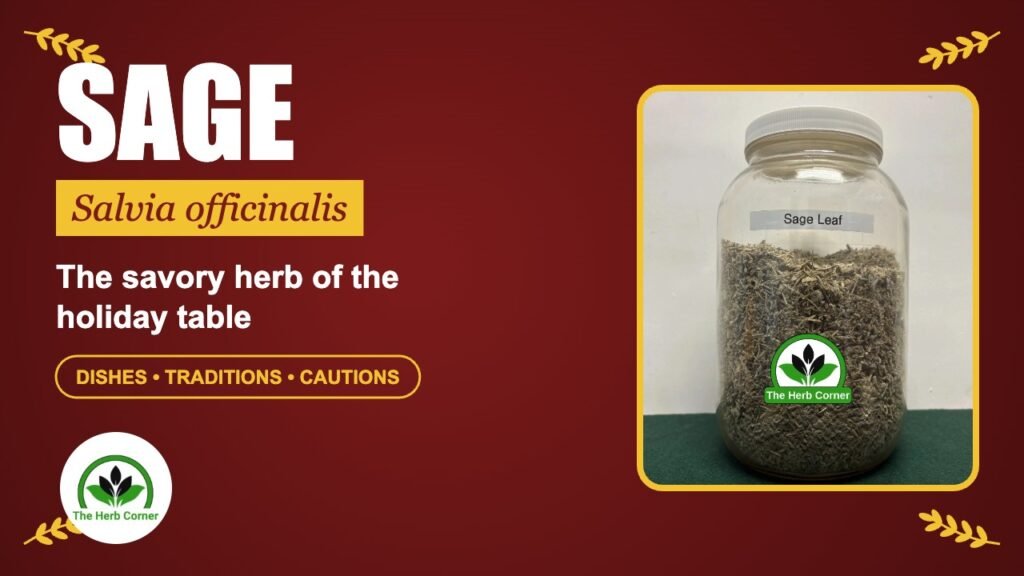
Few herbs say “holiday dinner” like sage (Salvia officinalis). Cooking with sage fills the kitchen with a savory, earthy aroma, from Thanksgiving stuffing to Christmas roasts. This small evergreen shrub belongs to the mint family. It grows wild from southwestern Germany to Spain, France, Italy, Greece and the Balkans. Its name comes from the Latin word salvere.
Please note: This article is for educational purposes only and reflects traditional and culinary uses. The Herb Corner does not give medical advice. Every reader should check with a certified medical professional before using any of our products.
Sage crossed the Atlantic early. Colonists grew it in America by the 1630s. In 1975, Joy of Cooking called it “perhaps the best known and loved of all American seasonings.”
How Cooks Use Sage
Sage has a mild but distinct taste. Its slight astringency cuts cleanly through fat, so it shines with rich holiday foods.
- Stuffing and sausage: Sage flavors classic stuffings for poultry and pork, and many sausages.
- Meats: It pairs well with chicken, turkey, pork and veal.
- Brown butter: Cooks fry the leaves in brown butter or olive oil until crisp.
- Beans: Italian cooks simmer sage with white beans and garlic.
- Tea: In Greece, people brew the leaves into a tea called faskomilo.
Six Classic Sage Dishes from Around the World
- Saltimbocca alla Romana (Italy): Cooks top thin veal slices with prosciutto and a sage leaf, then fry extra leaves in the pan. Pellegrino Artusi recorded the dish in the 1800s.
- Gnocchi with Brown Butter and Sage (Italy): This regional dish from Parma tosses potato dumplings in browned butter with sage and nutmeg.
- Thanksgiving Stuffing (United States): American cooks often scent bread or cornbread stuffing with dried sage, onions and celery.
- Sage and Onion Stuffing (United Kingdom): Cooks fry sage with onion and garlic and serve it with a roast dinner.
- Sage Derby Cheese (England): Cheesemakers in Derbyshire first made this green-marbled cheese in the 1600s, often for festive occasions.
- Lincolnshire Sausage (England): Butchers prize this pork sausage for its distinctive sage flavor.
Tips for Cooking with Sage
- Use dried sage sparingly. Drying concentrates the flavor, and sage can easily overpower a dish.
- Swap fresh for dried. One stuffing recipe uses ¼ cup minced fresh sage or 2 teaspoons dried.
- Cook it. Raw leaves taste harsh. Heat mellows them.
Traditional Medicinal Uses in Three Regions
Ancient Greece and Medieval Europe
The traditional use of sage for memory goes back to the ancient Greeks. In medieval Europe, people believed sage strengthened the memory and promoted wisdom.
Iran
Iranian folk medicine has used sage leaves traditionally for digestion, gas and cramps, and as a calming tonic.
Europe Today
A European Union herbal monograph lists sage leaf as a traditional herbal product for mild indigestion such as heartburn and bloating, excessive sweating, and irritation of the mouth or throat.
What the Science Says Today
The evidence remains limited. The U.S. National Center for Complementary and Integrative Health (NCCIH) says only small amounts of research exist. It notes that sage might reduce how often hot flashes happen, but the evidence on memory is small. Drugs.com states that no quality clinical trials back the traditional uses. Enjoy sage as a flavor first.
Warnings and Cautions
- Food vs. medicinal amounts: Sage is likely safe in food amounts. High doses or long-term medicinal use may be unsafe. Its thujone can cause seizures and harm the liver and nervous system.
- Essential oil: European regulators judge the risks of sage oil to outweigh its benefits. Thujone is toxic and may cause seizures at high doses. Never swallow sage essential oil.
- Pregnancy and breastfeeding: RxList calls medicinal sage likely unsafe in pregnancy. Nursing mothers should avoid it, because thujone may reduce milk supply.
- Children: Doctors have reported seizures in a young child and a newborn. Keep medicinal sage and sage oil away from children.
- Allergies: Avoid sage if it has caused a reaction before. Contact rashes and mouth irritation have occurred.
- Surgery: Stop medicinal sage at least 2 weeks before surgery.
- Medical conditions: Talk to a doctor first if you have a seizure disorder, diabetes, low or high blood pressure, or a hormone-sensitive condition. Spanish sage may act like estrogen.
Herb and Medication Interactions
RxList rates these interactions with medicinal amounts of sage as moderate:
- Seizure medicines: Phenobarbital, valproic acid, gabapentin, carbamazepine and phenytoin. Sage might make them work less well.
- Diabetes medicines: Insulin, glipizide, glyburide and pioglitazone. Blood sugar could drop too low.
- Blood pressure medicines: Captopril, enalapril, losartan, amlodipine and furosemide.
- Sedatives: Clonazepam, diazepam, lorazepam and zolpidem. The combination might cause too much sleepiness.
- Other medicines: Memory drugs such as donepezil, drugs such as atropine and scopolamine, estrogens, and drugs the liver breaks down, such as warfarin.
Drugs.com notes that few interactions are well documented. Still, ask your doctor or pharmacist before you combine medicinal sage with any medication.
Find Sage for Holiday Cooking at The Herb Corner
Ready for cooking with sage this season? We carry dried Sage Leaf (Salvia officinalis) for stuffing, roasts and brown butter. Visit our Melbourne, Florida shop or browse online. Hungry for more? Read our posts on allspice and hops, or explore the full Herb Blog.
The Herb Corner does not give medical advice. Please check with a certified medical professional before using any of our products. These statements have not been evaluated by the Food and Drug Administration. This product is not intended to diagnose, treat, cure or prevent any disease. Consult a qualified healthcare provider before using any herb for medicinal purposes, especially if you are pregnant, nursing, taking medication or have a medical condition.
Sources
- Kew Plants of the World Online: Salvia officinalis
- Drugs.com: Sage
- RxList: Sage
- NCCIH: Sage
- EU herbal monograph on Salvia officinalis leaf (EMA), via e-lactancia
- European Medicines Agency: Public statement on sage oil
- Review of Salvia officinalis in Iranian folk medicine (CORE)
- Britannica: Sage
- Saveur: The power of sage
- South China Morning Post: How to use sage
- McCormick: About sage
- Turismo Roma: Saltimbocca alla romana
- Saveur: Gnocchi with brown butter and sage
- Saveur: The inside story on American stuffing
- J. Kenji López-Alt: Classic sage and sausage stuffing
- BBC Good Food: Sage and onion stuffing
- Guild of Fine Food: Sage Derby lives on
- Lincolnshire Life: Protecting Lincolnshire sausage
- XpatAthens: A guide to Greek herbal teas