
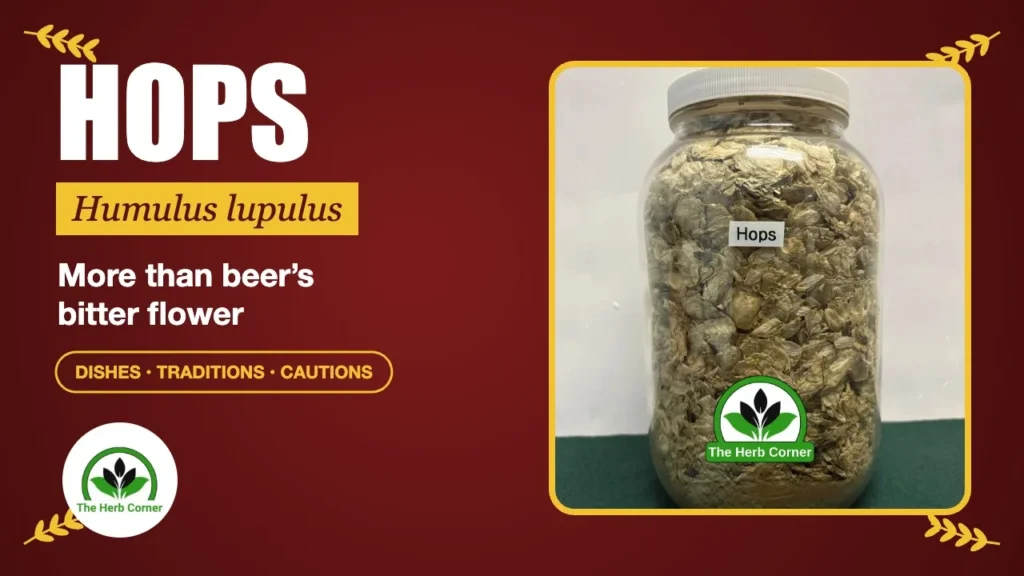
Most people know hops as the ingredient that gives beer its bitterness and aroma. The hops herb is the soft, papery cone of the female Humulus lupulus vine, a fast-climbing perennial in the cannabis family (Cannabaceae). Botanists generally agree the hop genus began in China and spread west into Europe and across to North America, and today the plant grows in temperate regions around the globe.
Please note: This article is for educational purposes only and reflects traditional and culinary uses. The Herb Corner does not give medical advice. Every reader should check with a certified medical professional before using any of our products.
How People Use the Hops Herb
Brewing is the big one. Hops were probably not part of the earliest beers, but they caught on once brewers noticed they helped beer keep. The first written mention of hops with beer comes from a monastery document in the Hallertau region of Bavaria, Germany, dated 736 CE. Commercial growing in North America began in Massachusetts in 1648, and the United States is now the largest producer.
Beyond beer, the hops herb shows up in herbal teas and calming herbal blends, and hop-filled pillows have a long history as a folk sleep aid. In the kitchen, cooks can also make hop-infused oils and salts from the cones. People in parts of Europe have eaten the young spring shoots as a vegetable since the time of the Roman writer Pliny. Diners prize them so highly, and their season is so short, that many people call them one of the most expensive vegetables in the world.
Four Dishes That Use Hops
- Risotto di bruscandoli (Veneto, Italy). In the Veneto, cooks stir wild hop shoots called bruscandoli into a spring risotto. These green, leafy shoots are more bitter than the Belgian kind, and in Venice they are part of everyday popular cooking.
- Frittata di bruscandoli (Italy). Italian cooks also fold the same wild shoots into a frittata, a traditional main course with a gently bitter bite.
- Jets de houblon with poached eggs (Poperinge, Belgium). Belgium’s hop country prizes the pale, underground shoots, called jets de houblon, which look a little like bean sprouts or white asparagus. The classic way to serve them is with poached eggs in a cream sauce, and some chefs make the sauce with Trappist beer. The season lasts only about a month in late winter and early spring.
- Pickled hop shoots (Washington, United States). Hop farms in Washington State pickle the shoots much like dilly beans, and one Walla Walla chef pickled them in an IPA-based brine for tacos.
Traditional Medicinal Uses in Three Regions
Germany and Central Europe. Hops have been part of European folk medicine for centuries. Hop pickers were known to become very drowsy during harvest, and hop-filled pillows, often warmed first, became a popular folk remedy for sleeplessness. People have also used hops traditionally to settle the stomach. Germany’s Commission E and the European herbal group ESCOP later approved hops for restlessness, anxiety and sleep disturbances.
North America (Native American peoples). Several Native American peoples used native hops on their own. Recorded uses include helping sleep and easing nervousness, intestinal pain, fever, earaches, coughs and rheumatism, and use as a tonic. By the late 1800s, hops were also a common part of mainstream American medicine for insomnia.
Turkey. A classic herbal reference records hops in Turkish folk use as a sedative and sleep aid, a nerve tonic, a diuretic and an astringent.
What the science says today. The evidence is weak and mixed. Small studies suggest a hops and valerian combination may improve sleep in people with mild insomnia, but more studies are needed, and a placebo-controlled trial of a hops product in 101 people with chronic insomnia found no difference from placebo. Hops contain 8-prenylnaringenin, one of the most potent plant estrogens known, but menopause guidelines rate the evidence for hops as limited and inconsistent, or insufficient to recommend. And no health benefit comes from drinking beer.
Warnings and Cautions
- Food amounts vs. medicinal amounts. Hops are generally recognized as safe as a food flavoring. Concentrated medicinal amounts, such as extracts and supplements, may carry more risk, and their strength varies from brand to brand.
- Pregnancy and breastfeeding. It is not known how hops affect pregnancy or whether they pass into breast milk. One professional reference advises avoiding them during pregnancy and breastfeeding.
- Allergies. Do not use hops if you are allergic to them. Handling dried hops can cause a skin rash in some people, and researchers have linked inhaling hop dust during harvest and processing to breathing problems. Stop and get help right away for signs of a severe reaction, such as wheezing or swelling of the face or throat.
- Children. Researchers have not studied hops well in children. Keep hops products out of children’s reach.
- Essential oils and extracts. Little safety research exists on concentrated hop oils and extracts, and medicinal quantities may pose more risk than food amounts. Do not take them by mouth without a professional’s guidance.
- Surgery. Herbal products may be unsafe before surgery or other medical procedures. Tell your surgeon and anesthesia team about any hops products well before a scheduled procedure.
- Medical conditions. Talk with your doctor first if you have a hormone-sensitive condition, such as breast or ovarian cancer, or kidney or liver problems.
- Driving. Calming products with hops often include other sedating herbs. Do not drive until you know how they affect you.
- Pets. Hops are dangerous for dogs. Dogs that ate leftover boiled hops from home brewing have developed a life-threatening overheating reaction, so store hops and spent hops where pets cannot reach them.
Herb and Medication Interactions
Research on hops and medicines is incomplete, and no interaction is considered well documented. The possible concerns reported so far are:
- Hormone therapy and hormonal birth control. Because of their plant estrogens, discuss hops with your provider if you use hormone replacement therapy or birth control that contains hormones.
- Sedatives and other calming products. Hops are traditionally used to promote sleep, and calming blends often add valerian or passionflower, which may affect alertness. Use care when combining them with sleep or anxiety medicines.
- Alprazolam (Xanax). Hops may lower blood levels of alprazolam. Professional references list this as low concern, with no action usually needed.
- Drugs processed by the liver (cytochrome P450 enzymes). Lab studies suggest hops may affect several of these enzymes, but a study in people found no clinically relevant effect from a standardized extract.
- Acetaminophen (Tylenol). In mice, some hops extracts slowed how quickly acetaminophen was cleared. Whether this matters in people is not known.
If you take any prescription or over-the-counter medicine, talk to your doctor or pharmacist before using hops medicinally.
Find It at The Herb Corner
Our Hops (Humulus lupulus) are the dried flower cones, ready for home brewing, tea blends or kitchen experiments. Stop by our Melbourne shop or browse the product page to learn more about our hops herb. For more plant profiles, read our Allspice guide or browse the full Herb Blog.
The Herb Corner does not give medical advice. Please check with a certified medical professional before using any of our products. These statements have not been evaluated by the Food and Drug Administration. This product is not intended to diagnose, treat, cure or prevent any disease. Consult a qualified healthcare provider before using any herb for medicinal purposes, especially if you are pregnant, nursing, taking medication or have a medical condition.
Sources
- Korpelainen H, Pietiläinen M. Hop (Humulus lupulus L.): Traditional and Present Use, and Future Potential. Economic Botany, 2021
- Memorial Sloan Kettering Cancer Center, About Herbs: Hops
- Drugs.com: Hops (professional monograph)
- WebMD: Hops, uses, side effects and interactions
- PeaceHealth Health Library: Hops
- Association for the Advancement of Restorative Medicine: Hops monograph
- BioGator: Humulus lupulus (Native American uses, citing Moerman 1986)
- USDA Dr. Duke’s Phytochemical and Ethnobotanical Databases: Humulus lupulus
- Atlas Obscura: Cooking with hops
- Smithsonian Magazine: The world’s most expensive vegetable
- Rocco Forte Hotels: Jets de houblon recipe
- GialloZafferano: Recipes with bruscandoli (hop shoots)

